Mennonite conformity in East Village
All My Puny SorrowsMennonite conformity in East Village is presented as a system of communal expectations, not simply a set of formal religious rules. Church authority reaches into family life, property, education, and artistic expression, while residents’ desire to be regarded as good Christians helps make its judgments effective. The Von Riesen family’s experience shows both the pressure to comply and the strain created when Elfrieda Von Riesen refuses to make herself smaller.
Communal Authority and Material Pressure
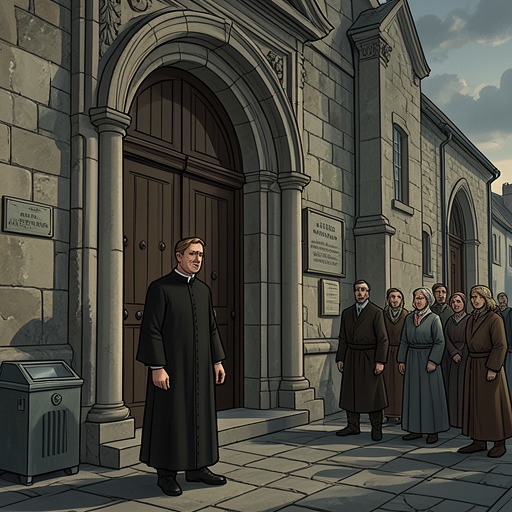
East Village began as a refuge from what its residents regarded as worldly vices, but the community’s religious identity became intertwined with commercial success. As inhabitants grew wealthier, they also appeared more pious, as though prosperity confirmed divine favour. In this atmosphere, a dispute over property could acquire a moral meaning beyond the transaction itself. When the car dealership next to the Von Riesen family home wanted the land to expand its parking lot, its owner applied persistent pressure until Jake Von Riesen sold the house. The sale was not his preference; nevertheless, the implication that he might be a bad Christian if he resisted made refusal feel like a possible sin. His wife, Lottie, urged him to fight, and Elfrieda tried to gather a petition against businesses expanding into people’s homes, but neither effort changed the outcome. After the family moved, Jake could see the vacant site of the old house across the highway from his lawn chair. The loss therefore remained visible in daily life, while the new house held the family’s separate responses to it: Lottie was restless, Jake slammed things around in the garage, and the children turned to their own pursuits.
The family’s limited power to challenge local standards was also shaped by gender and domestic hierarchy. Jake was regarded as an oddity: a quiet, depressive, studious man who took long walks and believed reading, writing, and reason could lead to a better life. Lottie would defend him only up to a point, because she was a loyal Mennonite wife who did not want to upset the household hierarchy; as a woman, she could also be easily overlooked. Their situation exposes a tension between private opposition and public compliance. Disagreement exists within the household, but the social order narrows the means by which it can be made effective.
Expression, Education, and the Limits of Permission
The community’s suspicion of individual display gave Elfrieda a reason to make her own identity visible. Inspired by ancient paintings she had seen on a rocky shore, she developed a mark built around her initials and the letters AMPS, with a large S enclosing the others. Her reference to All My Puny Sorrows turned an apparently mysterious sign into a personal declaration. When Yolandi Von Riesen warned that using her own initials would identify her and invite trouble, Elfrieda considered making the mark more obscure. The exchange shows both her impulse to assert herself and her awareness that visibility carried a cost. She later went around town with red paint, making the mark despite the community’s resistance to overt symbols of individual hope.
Her campaigns extended beyond the graffiti. Elfrieda went door to door proposing that East Village be renamed Shangri-La, collecting more than a hundred signatures by telling residents that the name came from the Bible and meant a place without pride. The comic ingenuity of the pitch does not make the challenge insignificant: she used the community’s own religious vocabulary to test its assumptions and recruit support. A church pastor once accused her of indulging her emotions; Elfrieda answered with theatrical humility rather than submission. These episodes establish a pattern in which her resistance is public, inventive, and difficult to contain within approved forms.
Education brought that conflict into the family home. At fifteen, Elfrieda planned to study music at university, a prospect that alarmed the church authorities, especially because she was a girl. The bishop arrived with a group of elders for what was described as a visit, though the family experienced such visits as incursions into private life. Jake received the men while Lottie stayed in the kitchen, deliberately refusing the expected role of hostess. When an elder warned that university would give Elfrieda ideas, Jake had little answer. The scene makes conformity operate through both official scrutiny and the family’s uneven ability to resist it: the elders speak with communal authority, while Lottie’s refusal to serve them is a quieter protest.
The Piano as Contest and Turning Point
The piano in the Von Riesen home was itself a breach of local convention. Instruments associated with public entertainment were not permitted in East Village, but Jake and Lottie kept one for Elfrieda after a city doctor recommended a creative outlet. For years, they covered it with sheets and sacks when elders came to visit. Although the parents eventually came to love her playing and sometimes requested familiar songs, the authorities discovered the instrument and discussed punishing Jake through excommunication. They ultimately allowed it to remain on the condition that the family ensure Elfrieda used it only for religious purposes. Permission was thus granted on terms that attempted to regulate what the music could mean.
When the elders returned to confront Elfrieda’s plans to leave for university, she began playing Rachmaninoff’s Prelude in G Minor, Op. 23 in the spare bedroom beside the front door. The piece had been her favourite, and she had worked on it for two years with a teacher from the conservatory in Winnipeg, who travelled to the house twice a week. As the music filled the house, the men fell silent and Lottie began to hum and sway. The scene reverses the usual arrangement: the elders have come to question the family, but Elfrieda’s performance commands the room without argument. Yolandi later understands it as the moment Elfrieda took control of her life and as a declaration that she could not remain in East Village. It also marks Jake’s loss of standing with the elders and of authority over a daughter who was becoming independent.
Inherited Silence and Later Family Conflict
The community’s silences are connected in the narrative to the family’s history of displacement and fear. Yolandi recalls that her grandparents came from a Mennonite village in Siberia in 1917, during the Bolshevik Revolution. Their family endured violence and forced migration; the surviving grandfather was transported to Canada. In response to that history, Jake’s father warned the next generation not to teach the children Plautdietsch if they wanted them to survive. Yolandi describes the language as carrying shame and associates Mennonite survival with bearing pain quietly. Her mother, Lottie, later studied to become a therapist and learned that suffering can pass from one generation to another. The novel places this inherited silence beside the local demands for conformity without treating the community as a single, unchanging tradition: the evidence is the family’s particular history and the rules they encounter in East Village.
The pressure to accept authority resurfaces in the family’s later crisis, though it takes a different form from the elders’ supervision. When Elfrieda is refusing food and asks that a doctor not be called, Yolandi calls an ambulance, creating an explicit conflict between Elfrieda’s wishes and her sister’s determination to keep her alive. The sisters recognize that they want incompatible things while continuing to love one another. Later, Elfrieda asks Yolandi to take her to Switzerland and to keep the request from Lottie and Nic, believing they would not let her go. Yolandi refuses to promise this. These scenes do not reduce the family’s decisions to the old community rules, but they show how questions of obedience, belief, protection, and personal choice remain difficult to separate. Against that background, the earlier piano performance stands as a formative image of resistance: a young woman makes herself heard in the very home where communal authority has come to contain her.